




 Automotive
 Motorcycle
 Storage
Battery Hub
VRLA Batteries: Valve-Regulated Lead-Acid Batteries Explained
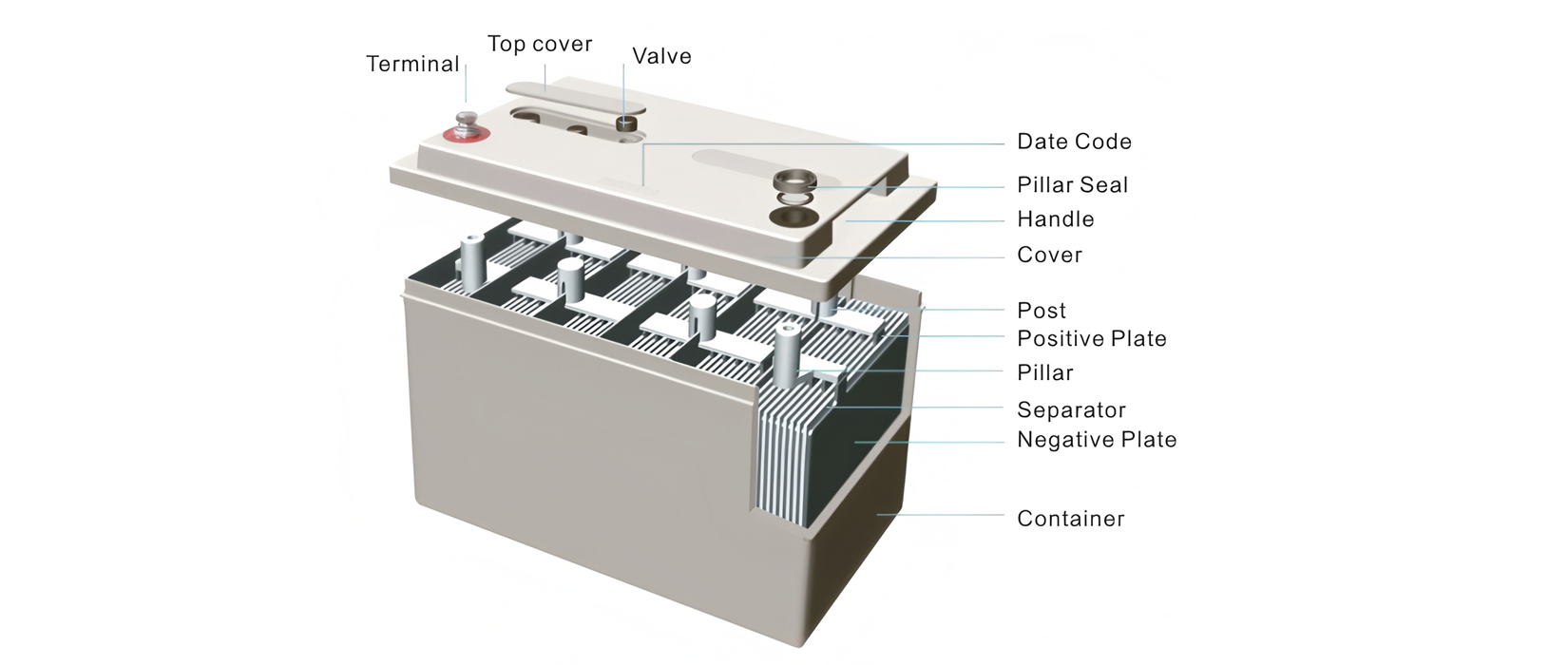
A VRLA (valve-regulated lead-acid) battery is a sealed lead-acid design that recombines the oxygen and hydrogen produced during charging back into water inside the cell, so it never needs watering. Two construction families dominate the market, AGM and GEL, and the tubular OPzV build extends the family into long-life stationary storage. Where they sit among flooded, AGM, GEL and OPzS designs is mapped in our Types of Lead-Acid Batteries guide; this page goes deep on the VRLA family itself.
KEY TAKEAWAY
VRLA batteries keep the same chemistry as every other lead-acid battery but trap their gases inside: oxygen moves from the positive plate to the negative plate and recombines into water. The result is a spill-proof, maintenance-free battery that needs no watering and no ventilated battery room. The trade-offs are tighter charging control and, in deep-cycle duty, shorter life than the best flooded tubular designs.
What Is a VRLA Battery?
VRLA stands for valve-regulated lead-acid. The name comes from the one-way, pressure-relief valve fitted to each cell, which holds gases inside just long enough for recombination to happen and releases only a small excess if charging goes badly wrong. Because the electrolyte is immobilized and the cell is sealed, VRLA batteries are widely sold as sealed lead-acid (SLA) or maintenance-free batteries; all three names describe the same recombination family.
They share the electrochemistry of any lead-acid battery, covered in our Lead-Acid Battery guide. What changes is the electrolyte handling: instead of free liquid that vents its gases, a VRLA cell holds either acid absorbed in a glass mat (AGM) or acid gelled with silica (GEL). A third family member, OPzV, pairs gel electrolyte with tubular positive plates for stationary storage.
How Oxygen Recombination Works
In a conventional flooded battery, overcharging decomposes water: oxygen evolves at the positive plate, hydrogen at the negative plate, and both vent out, taking water with them. Replacing that water is the main routine maintenance job of owning flooded batteries, and the vented hydrogen-oxygen mix is an explosion hazard that forces battery rooms to be ventilated.
VRLA cells close that loop. Design changes in the separator and electrolyte let oxygen diffuse from the positive plate across to the negative plate, where it reacts with the sponge lead in the presence of sulfuric acid:
Pb + ½O2 + H2SO4 → PbSO4 + H2O
The oxygen is consumed as fast as it can diffuse to the lead surface. Because the oxygen is reduced at the negative plate, the negative plate is prevented from reaching full charge, so it never starts to evolve hydrogen. No gas escapes, no water is lost, and the battery never needs watering - which is why VRLA batteries are called maintenance-free. Routine checks of voltage, terminals and connections are still part of ownership; what disappears is the watering and the acid-mist cleanup.
The cells should never be opened. Exposing the interior to air lets oxygen in from outside, disturbs the recombination balance and voids any warranty.
The Two VRLA Designs: AGM and GEL
AGM (Absorbed Glass Mat)
In AGM batteries the separator is replaced by a layer of porous glass mat. The cell is filled with just enough electrolyte to wet the plates and partially wet the mat, an electrolyte-starved condition. Because the mat is not saturated, oxygen generated at the positive plate diffuses straight through its unsaturated pores to the negative plate. The valve keeps the cell pressurized at roughly 2-5 psi so gas stays inside long enough for diffusion to complete. Some designs add excess negative active material as a second guard against hydrogen evolution. Low internal resistance makes AGM the natural choice for high-rate discharge: engine starting, start-stop systems and compact UPS backup.
GEL
In GEL batteries the plates keep conventional separators, and the cell is filled with sulfuric acid gelled by silica. The gel hardens like gelatin, immobilizing the electrolyte. As the gel ages it develops fine cracks and fissures, and these act as the channels through which oxygen migrates from positive to negative plate. Gel electrolyte tolerates deep discharge well and performs across a wide temperature range, which suits deep-cycle mobility and off-grid solar storage.
| Feature | AGM | GEL |
|---|---|---|
| Electrolyte | Absorbed in glass mat separator | Immobilized by silica gel |
| Oxygen path | Unsaturated pores of the mat | Cracks and fissures in the gel |
| Strengths | Low internal resistance, high-rate discharge | Deep-cycle tolerance, wide temperature range |
| Typical roles | Start-stop SLI, motorcycle, compact UPS | Solar and off-grid storage, mobility, deep cycle |
OPzV takes the GEL principle further: tubular positive plates paired with gel electrolyte, combining the deep-cycle durability of tubular construction with maintenance-free operation for telecom and solar installations. Our storage batteries cover this segment, including AGM, GEL, OPzV and OPzS stationary designs.
How VRLA Batteries Are Built
The recombination reaction is sensitive to impurities, so VRLA grids use very clean alloys: positive grids in lead-calcium-tin or pure lead, negative grids in lead-calcium. Lead-antimony alloys, common in cycling batteries, are ruled out here because antimony ions deposit on the negative plate and drive hydrogen evolution, breaking the recombination balance.
Assembly differs sharply between the two designs. AGM elements are built by cladding plates in glass felt, whose compression is controlled to set exactly how much acid it absorbs - over-saturation would block the oxygen path. GEL elements are stacked with standard separators and filled with gel, either directly or by forming with liquid acid first and exchanging it for gel. In both cases the container must resist distortion, since the cell lives under constant internal pressure.
The Advantages of VRLA Batteries
Minimal maintenance. Watering disappears, and with it the acid spray that corrodes terminals on flooded batteries. Periodic cleaning drops to simple terminal checks.
No gassing, no ventilation. Gases recombine inside the container, so battery compartments and cabinets need no special ventilation. VRLA batteries can sit next to sensitive electronic equipment, inside UPS cabinets and telecom shelters, where flooded batteries would not be allowed.
Any orientation. Immobilized electrolyte cannot spill, so these batteries operate on their side - a real advantage where installation space is tight.
Sealed for hard environments. The sealed construction tolerates wet or demanding conditions and constant vibration far better than open flooded cells.
The Limitations to Keep in Mind
Deep-cycle life. VRLA batteries lose capacity faster than flooded tubular designs under repeated deep discharge, a decline known as premature capacity loss (PCL). Two mechanisms drive it: a barrier layer of corrosion products grows between grid and active material, and the active material gradually loses particle-to-particle contact. Higher plate compression and prompt recharging both slow the decline. VRLA still outlasts flooded lead-calcium batteries in cycling duty, but for daily deep cycling the tubular flooded OPzS construction remains the stronger choice.
Float life is a balancing act. During float charging the current that would normally keep the negative plate charged is consumed reducing oxygen, which lets the negative plate self-discharge; raising the float current to fix that instead dries the cell out. This knife-edge makes float polarization harder to hold than in flooded designs. Traditional AGM and GEL builds deliver roughly 10 to 12 years of float life; tubular OPzV constructions extend beyond 20 years.
Alloy constraints. The ban on lead-antimony grids removed one lever for cycle life, and the industry answered with calcium-tin alloys and higher compression rather than a full fix.
Where VRLA Batteries Are Used
Standby and emergency backup. The classic VRLA territory: telephone and telecom switching, uninterruptible power systems (UPS), computer backup, cable TV, emergency lighting, fire and security alarms, and frequency regulation. Reduced maintenance is the deciding factor - nobody wants to water hundreds of cells in remote shelters.
Deep-cycle and motive use. Wheelchairs and scooters, golf cars, floor scrubbers, personnel carriers, marine trolling and house power, portable power, and renewable energy storage from solar and wind down to village power systems. Spill-proofing and zero gassing are what open these doors. Our motive power batteries serve this segment.
Starting and demanding environments. Start-stop vehicles, cars and light trucks with heavy accessory loads, diesel starting, on-highway and off-road trucking, marine starting, and wet environments - anywhere a sealed, spill-proof, vibration-tolerant design earns its keep.
| Use case group | Typical examples | Why VRLA fits |
|---|---|---|
| Standby and backup | Telecom switching, UPS, emergency lighting, alarms | No watering at scale, no ventilated battery room |
| Deep-cycle and motive | Wheelchairs, golf cars, scrubbers, solar storage | Spill-proof, zero gassing, deep-cycle GEL/OPzV builds |
| Starting and harsh duty | Start-stop cars, trucking, marine, wet environments | Sealed, vibration-tolerant, mounts in tight spaces |
VRLA vs Flooded Batteries
| Aspect | VRLA (AGM/GEL/OPzV) | Flooded |
|---|---|---|
| Watering | Never | Periodic topping up |
| Gases and ventilation | Recombined internally, no ventilation needed | Vents hydrogen and oxygen, room must be ventilated |
| Installation | Any orientation | Upright only |
| Spill risk | None | Liquid acid can spill and corrode |
| Electronics nearby | Safe | Acid mist and hydrogen rule it out |
| Deep-cycle life | Good, below tubular flooded | OPzS tubular builds are strongest |
| Cost | Higher | Lower |
Flooded batteries still win on price and on the longest float lives, but they fail in characteristic ways when misused: left sitting discharged, they sulfate and lose capacity permanently, and repeated over-discharge sheds active material from the plates, especially in automotive starting types. VRLA designs are more forgiving of both, provided charging voltage is kept within specification.
FAQs
What does VRLA stand for in batteries?
Valve-regulated lead-acid. Each cell carries a one-way pressure-relief valve that keeps gases inside long enough for oxygen to recombine into water at the negative plate, releasing only a small excess under fault conditions.
Are VRLA and sealed lead-acid (SLA) batteries the same thing?
Yes. Sealed lead-acid, SLA, maintenance-free and valve-regulated all describe the same recombination family. The two construction types inside it are AGM, with acid absorbed in a glass mat, and GEL, with acid immobilized by silica.
What is the difference between AGM and GEL batteries?
AGM holds electrolyte in a porous glass mat and moves oxygen through unsaturated pores, giving low internal resistance for high-rate discharge. GEL immobilizes electrolyte in silica gel and moves oxygen through fine cracks, trading some rate capability for deep-cycle and wide-temperature tolerance.
Can a VRLA battery be installed on its side?
Yes. The electrolyte is immobilized, so nothing spills and the plates stay wet in any orientation. Check the datasheet first, because a few designs still specify upright mounting for thermal reasons.
How long does a VRLA battery last?
In standby float service, traditional AGM and GEL designs typically reach 10 to 12 years and tubular OPzV constructions extend beyond 20 years. In deep-cycle duty, life depends on depth of discharge and charging discipline; VRLA delivers fewer deep cycles than flooded tubular designs but more than flooded lead-calcium batteries.