



 Current Site
 Automotive Battery Site
 Storage Battery Site
 B2B Platform Site
Battery Hub
Lead-Acid Battery
A lead-acid battery is a rechargeable battery that stores electrical energy through a chemical reaction between lead plates and sulfuric acid. Invented by Gaston Planté in 1859, it remains the oldest rechargeable battery technology still in wide use - and the backbone of automotive, motorcycle, motive power and stationary energy storage applications worldwide.
KEY TAKEAWAY
Each lead-acid cell produces about 2 volts, so a 12 V battery contains six cells in series. During discharge, lead dioxide and sponge lead react with sulfuric acid to form lead sulfate; charging reverses the reaction. Construction is simple and robust: plates, separators, electrolyte and a hard plastic case.
What Is a Lead-Acid Battery?
A lead-acid battery is a secondary (rechargeable) battery in which the positive electrode is lead dioxide (PbO2), the negative electrode is metallic sponge lead (Pb), and the electrolyte is diluted sulfuric acid. Each cell delivers a nominal voltage of about 2 volts, and the cells are connected in series to build higher system voltages: six cells for a 12 V automotive battery, three cells for a 6 V battery.
The chemistry behind this construction is what makes the battery rechargeable: the discharge products (lead sulfate and water) can be converted back into the original materials by passing current through the battery in the opposite direction. For the broader picture of how any battery converts chemistry into electricity, see our guide What Is a Battery?
How a Lead-Acid Battery Works
The working principle is a reversible chemical reaction known as the double sulfation theory. During discharge, both plates react with the sulfuric acid electrolyte and form lead sulfate (PbSO4), while the acid concentration in the electrolyte falls. During charging, the reaction runs in reverse: the lead sulfate is converted back into lead dioxide and sponge lead, and the acid returns to the electrolyte.
Discharge: Pb + PbO2 + 2H2SO4 = 2PbSO4 + 2H2O | Charge: 2PbSO4 + 2H2O = Pb + PbO2 + 2H2SO4
| State | Plates | Electrolyte (specific gravity) |
|---|---|---|
| Fully charged | PbO2 (+) and sponge lead (-) | Concentrated acid, SG about 1.265-1.285 |
| Discharging | Both plates turning into lead sulfate | Acid drawn into the plates, SG falls |
| Fully discharged | Both plates mostly lead sulfate | Diluted acid, close to water |
Because the electrolyte takes part in the reaction, the state of charge can be read directly from the specific gravity of the acid with a hydrometer. If a discharged battery is left un-recharged, the lead sulfate on the plates hardens into a form that resists normal charging - a condition called sulfation - which leads to permanent capacity loss. Timely recharging is therefore the single most important habit for lead-acid battery health.
Construction of a Lead-Acid Battery
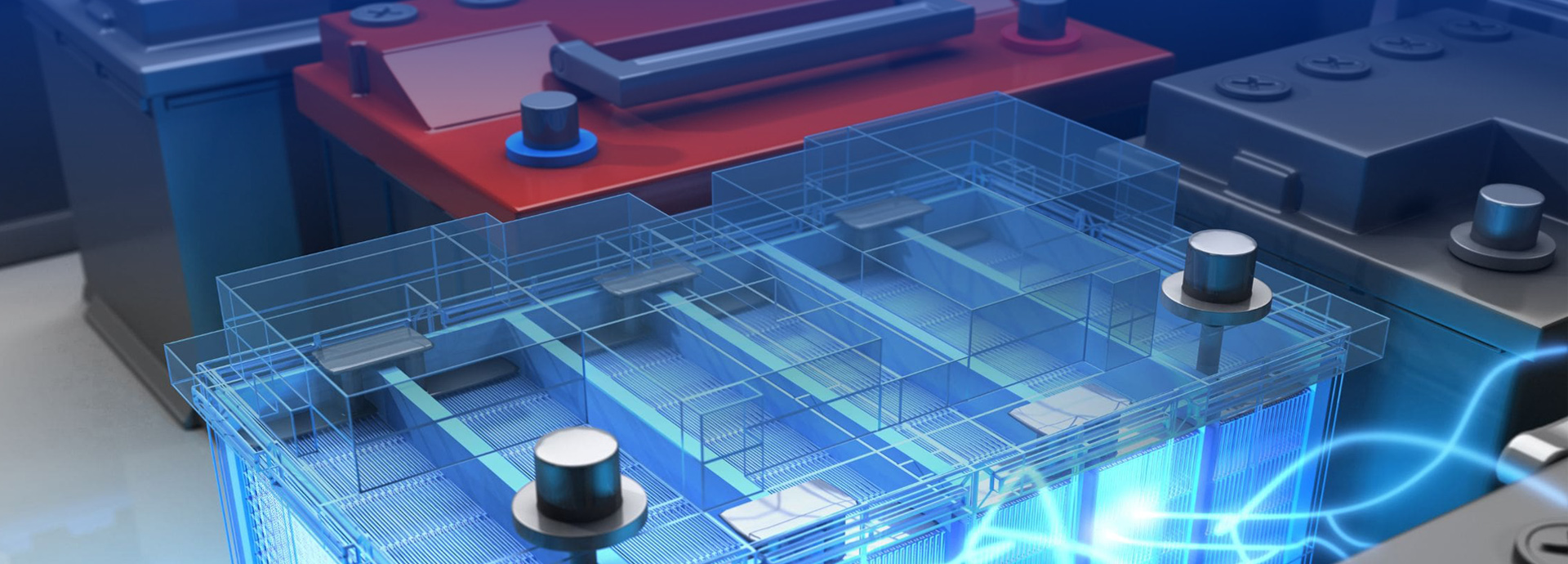
A lead-acid battery is deliberately simple in design: heavy, flat plates are stacked with porous separators between them, immersed in electrolyte, and sealed inside an impact- and acid-resistant case. Nine components do all the work:
| Component | Function |
|---|---|
| Positive plate | Lead dioxide (PbO2) active material on a lead alloy grid; source of electrons during discharge |
| Negative plate | Metallic sponge lead active material on a grid; receiver of electrons during charge |
| Grid | Lead alloy framework that holds the active material and conducts current |
| Separator | Porous, non-conductive divider that keeps plates apart while letting ions pass |
| Electrolyte | Diluted sulfuric acid; participates in the charge/discharge reaction |
| Intercell connectors | Lead links that connect cells in series inside the case |
| Container and cover | Impact- and acid-resistant polypropylene case holding plates and electrolyte |
| Vents | Allow gases to escape while retaining electrolyte; flame-arresting designs improve safety |
| Terminals | External contacts (top posts, side, or dual) for the vehicle or equipment circuit |
Main Types of Lead-Acid Batteries
Lead-acid batteries fall into two broad families. Flooded (vented) batteries keep the plates immersed in liquid electrolyte and may require periodic watering. Valve-regulated (VRLA) batteries immobilize the electrolyte - as absorbed glass mat (AGM) or as gelled silica (GEL) - so they can be sealed and operated free of maintenance. Within these families, tubular-plate constructions such as OPzV and OPzS are engineered for long service in stationary and deep-cycle duty.
Each type trades off cost, maintenance, vibration resistance, deep-cycle endurance and starting power in a different way, and each is matched to different applications - from SLI starting in cars to solar energy storage. We compare all of them in detail in our dedicated guide, Types of Lead-Acid Batteries.
Key Lead-Acid Battery Technologies
Within the main types, a number of proven technologies refine the basic lead-acid concept for specific duties - start-stop idling, deep cycling, long float life in remote power systems. Our engineering team documents each of them in the Technologies section of this site:
| Technology | Where it fits | Details |
|---|---|---|
| SMF | Maintenance-free starting power for cars and commercial vehicles | SMF Technology for Automotive |
| EFB | Enhanced flooded battery for entry-level start-stop vehicles | EFB Technology for Start-Stop Vehicles |
| AGM (start-stop) | Absorbed glass mat for advanced start-stop and high electrical demand | AGM Technology for Advanced Start-Stop Vehicles |
| AGM (motorcycle) | Sealed, vibration-resistant power for motorcycle and powersports | AGM Technology for Motorcycle & Powersports |
| AGM (storage) | Long float life for stationary energy storage and backup | AGM Technology for Stationary Energy Storage |
| GEL | Gelled electrolyte for reliable deep-cycle service | GEL Technology for Reliable Deep Cycle Power |
| OPzV | Tubular GEL construction for stationary power | OPzV Technology: Tubular GEL for Stationary Power |
| OPzS | Vented tubular construction for stationary power | OPzS Technology: Vented Tubular for Stationary Power |
FAQs
How many cells are in a 12 volt lead-acid battery?
Six. Each lead-acid cell produces about 2 volts, and the six cells are connected in series inside the case to deliver 12 volts. A 6 V battery contains three cells.
What is the difference between AGM, GEL and flooded lead-acid batteries?
The difference is the state of the electrolyte. Flooded batteries keep liquid acid that can be checked and topped up; AGM batteries absorb the acid in glass fiber mats; GEL batteries fix the acid in a silica gel. AGM and GEL are both sealed VRLA constructions that need no watering.
What causes sulfation in a lead-acid battery?
Sulfation develops when a battery is stored or cycled in a partially discharged state, especially at warm temperatures: the lead sulfate formed during discharge hardens into a form that resists normal recharging, causing permanent capacity loss. Recharging promptly after each discharge prevents it.
Can a lead-acid battery freeze?
A fully charged battery will not freeze until about -65°F, because its electrolyte is a strong acid solution. A deeply discharged battery, whose electrolyte has become mostly water, can freeze at temperatures as high as 32°F - one more reason to keep the battery charged.
How should a lead-acid battery be maintained during storage?
Check the state of charge periodically and recharge when it falls, keep terminals clean and tight, and store the battery cool and dry. A self-discharging battery that is left unattended can sulfate deeply and become unusable, so a periodic charging routine - or a connected automatic charger - protects it through long idle periods.